Timber Sale Contracts
Too often timber harvests are conducted with no more than a nod and a handshake between the parties involved. Although this procedure sometimes works, a written agreement is far better.
What can we help you find?
Fire restrictions are a critical tool used by land management agencies to reduce the risk of unwanted human-caused wildfires, especially during periods of very high or extreme fire danger.
Restrictions are implemented using standardized guidelines adopted across agencies statewide and are part of a broader wildfire prevention strategy that may also include increased public outreach, signage, and media campaigns. When fire restrictions are in effect, they apply to all lands within the designated area—regardless of ownership—and must be followed by law.
The statewide interagency plan can be downloaded here: 2025 Idaho Fire Restrictions Plan
Fire restrictions are a last resort to prevent unwanted human caused fires. During Closed Fire Season (May 10–October 20), burning is regulated on state and private lands through burn permits where specific types of burning may or may not be allowed. During this same time frame, the BLM issues an annual Prevention Order that limits certain types of activities on public lands they administer.
Federal, State, Tribal and private lands (outside of city limits and incorporated areas), which lie within the restriction area boundary.
The maximum penalty for violating a fire restriction order differs depending on the enforcement agency:
Forest Service
BLM
State of Idaho
Bureau of Indian Affairs/Tribal
A developed recreation site is an area that has been improved or developed for recreation. A developed recreation site is signed as a privately owned commercial campground, tribal, or agency owned campground or picnic area.
No. Your public lands remain open for use. However, in the event of a fire, there may be temporary road or area closures associated with the incident to provide for public and firefighter safety.
Fire restrictions in Idaho are managed through a collaborative, interagency process outlined in the Idaho Fire Restrictions Plan. This plan guides how cooperating agencies coordinate the implementation of fire restrictions and closures.
By working together, agencies can ensure consistency across jurisdictions and clearly define restriction boundaries so they are easy for the public to understand and comply with.
Idaho’s fire restrictions group includes representatives from the Idaho Department of Lands, the Bureau of Land Management, the USDA Forest Service, the Bureau of Indian Affairs, Tribal governments, and local fire management personnel.
Fire restrictions and closures can be invoked on state, federal, and private lands under federal and state laws. Here are references to these authorities:
USDA Forest Service Authorities
Bureau of Land Management (BLM)
Bureau of Indian Affairs (BIA)/ Tribal
State of Idaho, Idaho Department of Lands (IDL)
Fire restrictions have not yet been implemented in green areas. Yellow areas are in Stage 1 Fire Restrictions. Red areas are in Stage 2 Fire Restrictions. You can also click on an area in the map and see any fire restrictions in the dialog box.
Too often timber harvests are conducted with no more than a nod and a handshake between the parties involved. Although this procedure sometimes works, a written agreement is far better.
Experienced landowners know that a successful timber harvest requires planning. After management objectives, silvicultural prescriptions, and contractual requirements are formulated, a purchaser must be found. Usually, timber sale purchasers are responsible for logging operations. They can make you satisfied or disappointed in the results.
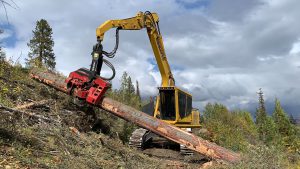
Administering a Timber Harvest In technical terms, timber sale administration is the supervision of harvest activities to achieve silvicultural and economic objectives through sound logging practices and proper log utilization. In plain English, sale administration is telling a logger what you want before it’s too late. Communication and cooperation between a landowner and the logger […]
To the average forest landowner the vast array of cost-share programs must seem like a jumbled soup of alphabet acronyms. There’s, CRP, EQIP, CSP, HFRP among others. They are administered by agencies called FSA, IDL, NRCS and IDF&G. While the programs can providing worthwhile incentives to landowners wanting to enhance the management of their property, many factors make it difficult for landowners to understand their options.
In technical terms, timber sale administration is the supervision of harvest activities to achieve silvicultural and economic objectives through sound logging practices and proper log utilization. In plain English, sale administration is telling a logger what you want before it’s too late.