
Timber Sale Contracts
Too often timber harvests are conducted with no more than a nod and a handshake between the parties involved. Although this procedure sometimes works, a written agreement is far better.
What can we help you find?

Experienced landowners know that a successful timber harvest requires planning. After management objectives, silvicultural prescriptions, and contractual requirements are formulated, a purchaser must be found. Usually, timber sale purchasers are responsible for logging operations. They can make you satisfied or disappointed in the results.
There are plenty of competent purchasers in the market. Consulting foresters, logging contractors, log brokers, and saw mills all vie for stumpage. Names and addresses of local timber buyers can be obtained from your local IDL office, extension agent, or telephone directory. Once potential purchasers are known, the following procedures may be helpful in selecting a purchaser.
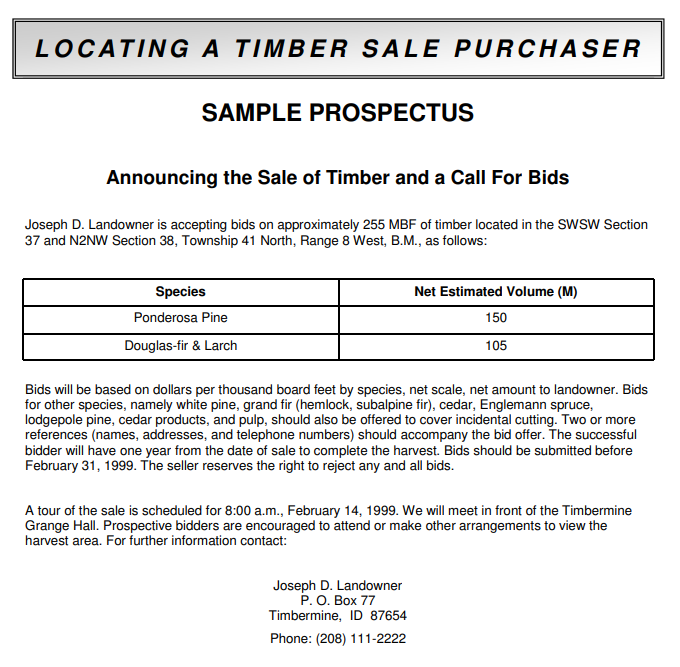
A prospectus is a notice of request for bids with a brief description of the planned harvest. It usually lists the species, volumes, and products being sold, a legal description of the harvest area, a tentative sale date, the seller’s name and address, and any other pertinent information. Explain the exact form and details wanted for the bid price.
Interested purchasers need an opportunity to examine the timber, understand the harvest objectives, review the sale contract, and estimate their logging costs. This can be accomplished with a tour of the harvest area. Arrange group or individual meetings, which ever is more convenient.
The most important aspect of the tour is communication. Purchasers need to understand the seller’s goals, requirements, and desires so they can offer competitive bids. Likewise, sellers have an opportunity to glean information about logging and log markets. Comments or criticisms from seasoned woodsmen may be useful in revising the harvest plan.
Customarily, bids are accepted two to four weeks after the prospectus is sent out. Depending on how the timber is being sold, bids are based on the price per unit volume (i.e. thousand board feet , cords, etc.), the price of the entire sale, or the costs of logging per unit volume. Loggers charge no fee for the “estimates” since they are trying to land a job. Always reserve the right to reject any or all bids.
Since the bidder of the highest amount to the landowner may not always be the best choice, have interested parties submit references with their bids. Investigate any likely candidate before awarding the contract. Choose contractors based on their track record as well as their price.
Once a purchaser is selected and the contracts are signed, maintain communication. The purchaser deserves seller input and constructive criticism so adjustments can be made. Responsible contractors want to do a good job. Administer your harvest with this attitude in mind.
Too often timber harvests are conducted with no more than a nod and a handshake between the parties involved. Although this procedure sometimes works, a written agreement is far better.
To the average forest landowner the vast array of cost-share programs must seem like a jumbled soup of alphabet acronyms. There’s, CRP, EQIP, CSP, HFRP among others. They are administered by agencies called FSA, IDL, NRCS and IDF&G. While the programs can providing worthwhile incentives to landowners wanting to enhance the management of their property, many factors make it difficult for landowners to understand their options.
Informed family forest landowners know you can harvest trees, make a profit and still have a healthy thriving woodlot that looks good. Sound impossible? Well, the truth is a forest can be improved with a successful timber harvest. Planning is the key and good planning depends on making good decisions.
Slash cleanup after harvest can serve many good and positive purposes; it protects the area from fire and insect damage, provides for silvicultural and timber stand improvements, provides grazing capabilities for wildlife, and last, but not least, makes the logging job look good.